You have been Successfully Subscribed to Newsletter


Two-wheeler Licence Test in India: Preparation Tips
Dec 5, 2025 • 10 Min Read
Table of Contents
- Eligibility Criteria and Documents Required
- Test Format for 2 Wheeler Driving License Exam
- Key Skills You Must Practise Before the Test
- How to Take an 8 in a Driving Test: Step By Step Guide
- Common Mistakes to Avoid During the Two-Wheeler Driving Test
- Roll Out with Confidence
Your learner’s permit is ticking down, and the two-wheeler licence test date is circled on the calendar? Relax, you’ve got this! Two-wheelers accounted for nearly 2.4 crores units produced in FY 2024 25, dwarfing every other vehicle segment in India. With so many of us on two-wheelers, the rules (and examiners) have become stricter. Automated driving test tracks in cities like New Delhi report failure rates of around 50%, with some centres recording pass rates below 45%. In contrast, Punjab’s Mohali centre has an 82% pass rate for two-wheeler applicants; a clear sign that preparation pays off.
This guide will walk you through everything, from paperwork to that nerve-racking “8”, so you ride out with a fresh licence and the wind in your helmet.
Eligibility Criteria and Documents Required
Before you book your test slot, it's important to check if you meet the basic eligibility for the two-wheeler licence test.
Who Can Apply?
- Age:Minimum 16 years for gearless scooters up to 50 cc, 18 years for all other bikes.
- Education:No minimum qualification, but basic road-sign literacy is a must (you’ll face 15 theory questions).
- Medical fitness:Form 1A if you’re over 40 or have declared health conditions.
Paperwork Checklist
| Proof of age and address (Aadhaar, passport, etc.) | Upload colour scans on Parivahan portal; skip RTO queues |
|---|---|
| Form 2 (application) and Form 1 (self declaration of fitness) | Fill it out online to avoid handwriting errors |
| Passport-size photos | Carry two extra. Some centres still insist on this |
| Learner’s Licence (LL) | Must be 30 days old but under 6 months |
| Fee receipt (₹300–₹500) | Pay via UPI on the portal and keep your transaction receipt |
Test Format for 2-Wheeler Driving License Exam
Before you hit the road, you’ll need to clear the 2-wheeler driving license exam, which tests both your riding skills and traffic awareness through a series of practical and verbal assessments.
| Pre-ride check | You identify switches, tyres, and lights. | Pass/Fail |
| Straight ride and gear shift | 30-40 m stretch, smooth acceleration, brake within the box. | 20 marks |
| The Figure 8 | Two complete loops without your feet touching the ground. | 50 marks |
| Emergency brake | Stop within 2 m of the marker at 30 km/h. | 10 marks |
| Slope start (varies by state) | Halt on the 15% incline; move without rollback. | 10 marks |
| Traffic awareness Q&A | Signs flashed on a screen. Answer verbally. | 10 marks |
| Passing score | 70 % overall, zero critical errors (stall, cone hit) |
Disclaimer: The test structure and scoring may vary slightly depending on your state or RTO. This format reflects commonly followed patterns at automated and manual testing centres across India.
Key Skills You Must Practice Before the Test
Passing the two-wheeler licence test isn't just about knowing the rules; it's about confidently applying them in a real-world setting. Practicing the right skills will give you the control, awareness, and confidence to glide through the test like a pro. Here's what you should focus on:
- Clutch-throttle harmony:Practice feathering the clutch at 10 km/h to avoid jerks.
- Rear-brake finesse:80% of control on low-speed manoeuvres comes from your rear brake; ride empty parking lots until it’s instinctive.
- Shoulder checks:Always glance over your shoulder before merging or turning. It shows awareness and safe riding habits; something examiners are trained to look for.
- The emergency stop drill:Rear brake first, squeeze front gently, down shift, eyes up.
- Slow-speed balance:Practice riding as slowly as possible for 20 m; it sharpens core balance for the “8”.
Safety hack: Pair these sessions with decent coverage like Royal Sundaram's Two Wheeler Insurance; you’re protected even during extra practice runs.
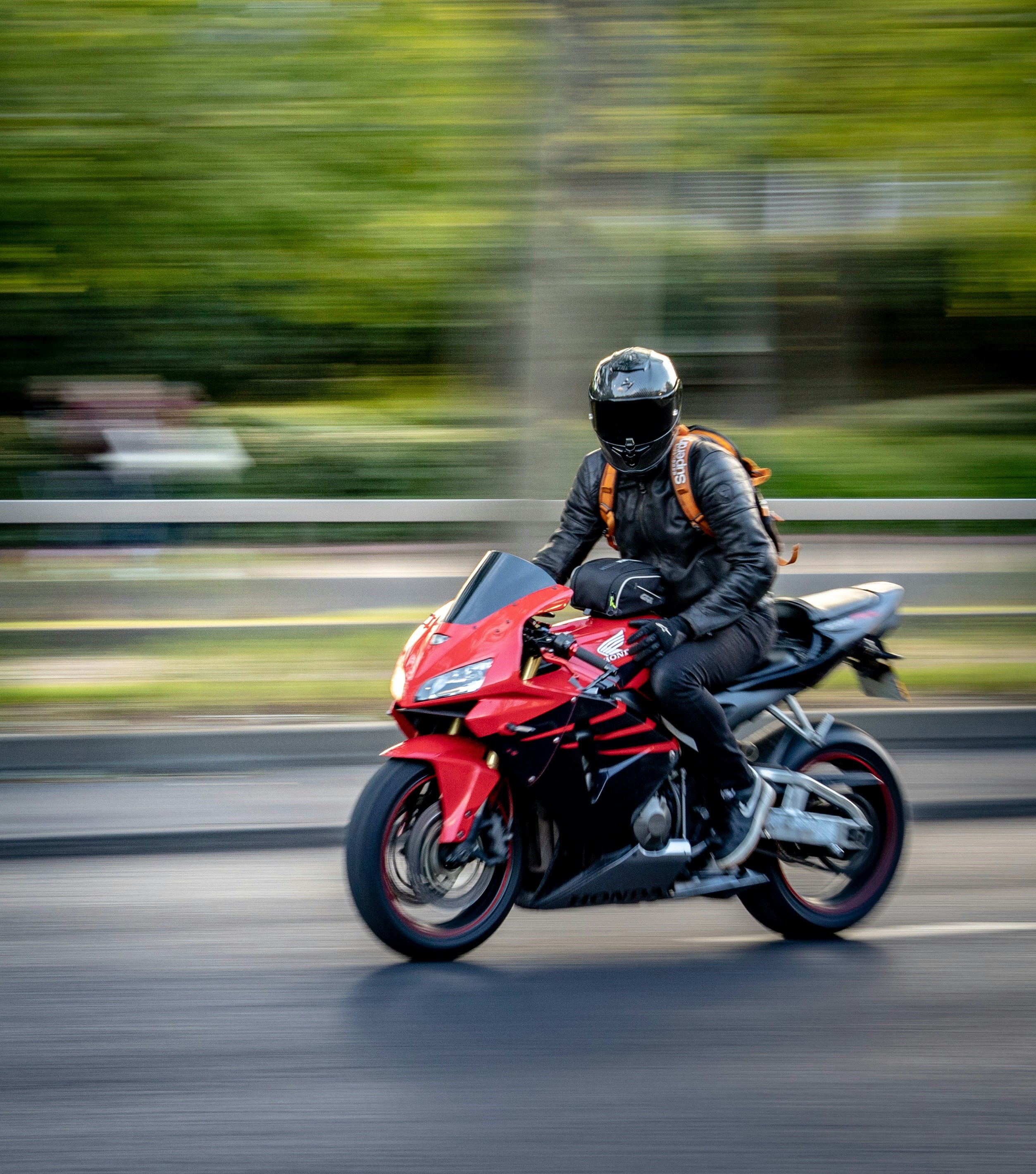
How to Take an 8 in a Driving Test: A Step-By-Step Guide
The figure-8 is the trickiest part of the two-wheeler licence test and often the reason many riders stumble. But with the right technique and a bit of practice, you can glide through it like a pro.
- Visualize the path
Walk the figure first. Note cone spacing—usually 5–7 m.
- Enter wide, exit tight
Approach from the left edge, swing wide, tipping the bike just enough to carve a clean arc.
- Look where you want to go
Turn your head, not just your eyes; the bike follows your gaze.
- Steady throttle, feathered clutch
Hold 2,000–3,000 rpm; slip the clutch to adjust speed.
- Rear-brake modulation
Light pressure stabilizes the bike. Avoid grabbing the front brake mid-lean.
- Half-point check
As you cross the imaginary midline of the “8”, shift weight to the outer peg and prep for the opposite loop.
- Exit smoothly
Straighten up only after clearing the last cone; don’t rush the throttle.
- Dabbing a foot in the “8”:Instant fail in many automated centres.
- Over-revving at the start:Sensors flag sudden RPM spikes.
- Ignoring mirrors:Examiners count mirror checks; miss more than two, and you lose marks.
- Stalling:Practice clutch control; a stall equals critical error.
- Wrong documents:An incorrect chassis number on Form 2 voids the attempt; double-check entries.
- Skipping renewal window:Learner’s Licence older than six months? You’ll need to re apply.
- Re-attempt frenzy:After Kerala tightened its driving test rules in 2024, pass rates dropped to around 40-45%, down from nearly 100% earlier. Many candidates rushed to reappear without retraining, possibly contributing to the high failure rate.
Common Mistakes to Avoid During the Two-Wheeler Driving Test
Knowing what not to do during your two-wheeler licence test can be just as important as knowing what to do.
Roll Out with Confidence
Nailing the two-wheeler license test boils down to three words: practice, paperwork, and patience. Prep with disciplined drills, show up with pristine form, and keep cool on the track. Thanks to the new private-centre option, you even get to choose a venue that fits your timetable.
Before you roar off on your newly licensed machine, lock in protection that grows with you. Royal Sundaram's Two Wheeler Insurance offers add-ons like NCB Protectors and instant digital certificates, so your premiums can shrink as your skills rise.


Discover the perfect insurance plan for you!
Get your free quote now!
Get StartedBy Clicking on Get Started, You agree to our Terms and Conditions and override DNC/NDNC registration.
More like this
View more